
How AI Actually Matches a Resume to a Job (And Why It Sometimes Gets It Wrong)
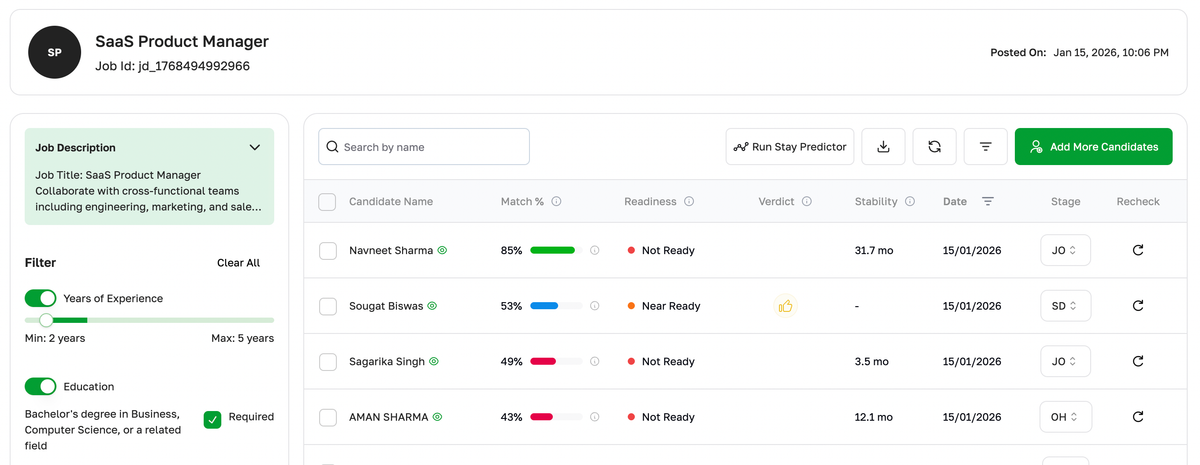
If you've ever hired for a role, you know the drill. A single opening can pull in hundreds of applications, and somewhere in that pile are candidates who describe the same experience in completely different words. Some bury their best qualifications under pages of irrelevant detail. Others look perfect on paper until you dig in and realize the resume just doesn't say much at all.
This is the problem AI-powered candidate matching was built to solve. And while it's genuinely useful, it isn't magic, and it definitely isn't as simple as counting keywords.
A candidate can look like a great fit to a human recruiter and still come out with a mediocre match score. That gap usually comes down to one thing: what information the system actually has to work with, how that information is worded, and how closely it lines up with what the role requires.
Let's walk through how this really works.
What is the AI actually comparing?
At the most basic level, it's comparing two documents: the job description and the resume. But a decent matching system doesn't just scan for identical words appearing in both. It looks at things like skills, job titles, work history, industry background, years of experience, responsibilities, certifications, and career trajectory.
The underlying question it's trying to answer is simple to state and hard to solve well: how closely does this person's professional background line up with what the job actually needs?
A purely keyword-driven tool might search for the phrase "Project Manager" and stop there. A more context-aware system looks at what the candidate actually did led cross-functional teams, managed timelines, coordinated stakeholders, delivered implementations and recognizes that this is relevant project management experience even if the candidate never used the exact job title.
Platforms like OptyMatch, which combines resume parsing with AI scoring and job matching, lean into this idea. Rather than relying purely on keyword overlap, the system is built to recognize relevant experience even when the candidate describes it using different terminology, drawing on hundreds of roles, skill, and experience signals to make that call.
Step one: the job description sets the benchmark
Before any resume can be evaluated, the system has to understand what it's evaluating against.
Take a posting like: Senior Data Analyst, 4+ years of experience, SQL, Power BI, data visualization, stakeholder reporting, business analytics.
Break that down and you've got several distinct signals: a minimum years-of-experience threshold, specific technical tools, functional skills like visualization and analytics, and a business responsibility around reporting to stakeholders.
This matters more than it might seem, because a job title alone tells you very little. A "Data Analyst" role at one company might be almost entirely financial reporting. At another, it's product analytics. At a third, it leans heavily into machine learning. The title is the same; the job is not. The description is what actually defines the role.
Step two: the resume gets parsed into something usable
Resumes are messy by nature. People format them differently, use different section headers, and describe similar jobs with wildly different titles.
One person calls themselves a Business Intelligence Analyst. Another goes with Data & Reporting Analyst. A third writes MIS Analyst. Someone else skips a job title altogether and just describes what they did.
This is where resume parsing comes in pulling unstructured text and turning it into structured, comparable data. OptyMatch's platform does this as a first step before any matching or scoring happens, because you can't compare a resume to a job until you actually understand what's in the resume.
Step three: looking past exact keywords
This is arguably where AI matching earns its keep.
Say a job description asks for vendor management experience, but the resume says the candidate "managed supplier relationships across strategic procurement categories." A basic keyword search would probably miss that connection entirely. A context-aware system is more likely to recognize that supplier relationship management and vendor management describe closely related work.
Same idea with customer relationship management versus "managed a portfolio of enterprise accounts and developed long-term client relationships." Different words, similar experience.
This is the core advantage AI matching has over a simple keyword filter, it can catch relevant experience that's worded differently than the job posting.
Optymatch.ai
Matching that reads between the lines.
Optymatch scores every resume against the job using 500+ role, skill, and experience signals — so relevant experience gets found, even when the wording doesn't match.
Talk to usWhy doesn't AI always pick the "obviously right" candidate?
Because the quality of the match depends heavily on the quality of the information feeding it. Here are the most common reasons a genuinely strong candidate ends up with a weaker score than they deserve.
- The resume doesn't describe the experience well enough. A candidate might have five solid years of project management under their belt, but if their resume just says "worked with different teams and handled multiple projects," the system has almost nothing to work with. Compare that to something like "managed 12 technology implementation projects from planning through delivery, coordinating cross-functional teams of up to 15 people." Same candidate, wildly different amount of usable signal. The person didn't become more qualified between those two versions, the resume just got more informative.
- Terminology doesn't match up. A company looking for a Talent Acquisition Specialist might overlook a candidate who calls themselves a Recruitment Partner, even if their actual responsibilities: sourcing, screening, managing hiring pipelines, supporting offer negotiations are exactly what the role needs. This is exactly why matching systems need to understand relationships between roles and skills rather than just checking for identical phrases.
- There's too much irrelevant information. A backend engineer applying with a resume full of Java, Spring Boot, SQL, APIs, and AWS experience is in good shape until that resume also lists 25 unrelated skills from old internships and college projects. All that noise makes it harder for both the algorithm and the recruiter to see what actually matters. A tighter, more focused resume tends to score better, not because it hides experience, but because it makes the relevant experience easier to find.
- The job description itself is vague. Sometimes the resume isn't the problem. A posting asking for "a dynamic professional with strong communication skills, leadership capabilities, and a passion for innovation" gives the system almost nothing concrete to search for — no required tools, no experience threshold, no clear responsibilities. Garbage in, garbage out applies here just as much as anywhere else. Better matching starts with better job descriptions.
- Transferable skills are hard to capture. Someone moving from Business Analyst to Product Manager might already have stakeholder management, requirements gathering, data analysis, and cross-functional collaboration experience everything a PM role needs but their last job title doesn't say "Product Manager." A simplistic tool might flag that as a mismatch. A more sophisticated one looks past the title to the underlying responsibilities, which matters even more now that people move across roles and industries more freely than they used to.
- Skills match, but the role doesn't. A candidate with ten years of Excel, Power BI, budgeting, and forecasting experience looks like a strong fit for a Senior Financial Analyst opening on paper. But if most of those ten years were spent in an unrelated operational role with only light exposure to actual financial analysis, the real-world fit is weaker than the skills list suggests. Good matching has to weigh experience in context, not just check boxes.
A quick example
Picture a Senior Marketing Manager posting asking for 7+ years of experience, digital marketing, SEO, campaign management, team leadership, analytics, and budget management.
- Candidate A has eight years of experience running digital campaigns, SEO, and marketing analytics, has managed annual budgets in the crores, and has led a team of six.
- Candidate B has ten years of experience but their background is mostly communication, social media, customer service, general office work, and event coordination.
Candidate B technically has more total years on the job. But Candidate A's experience actually maps onto what the role needs. Years of experience by themselves don't determine fit, the relationship between what someone has actually done and what the job requires does.
Where this actually helps recruiters
The real payoff shows up at volume. Instead of manually working through hundreds or thousands of resumes from scratch, recruiters using AI-powered tools can parse resumes automatically, surface relevant skills, compare candidates against requirements, rank or score applicants, and keep candidate data organized and searchable. OptyMatch frames its own toolset this way: parsing, scoring, tagging, ATS integration, and matching working together as one workflow.
The point isn't just speed for its own sake. It's freeing up recruiter time for the parts of hiring that still genuinely require a human reading between the lines, judging fit, having actual conversations with people.
AI scores candidates. It doesn't hire them.
This distinction is worth being blunt about: a match score is an input to a decision, not the decision itself.
Two candidates can land on nearly identical scores and still be very different hires. One might have deeper technical chops. Another might bring stronger industry context. A third might have leadership experience that never quite gets picked up by the algorithm at all.
Recruiters still have to weigh interview performance, communication style, motivation, team fit, references, compensation expectations, and where someone actually wants their career to go. None of that shows up in a match score. OptyMatch itself pitches its AI as something meant to support recruiters rather than replace their judgment, freeing them up to focus on strategy and candidate relationships instead of manual screening.
How to actually improve match quality
Better matching doesn't start with a better algorithm. It starts with better inputs on both sides.
Write job descriptions that are specific about required skills, experience, and responsibilities instead of vague buzzwords. Separate the requirements that are truly non-negotiable from the ones that are just nice to have. Keep candidate data clean and structured so the system has something real to work with. Don't fixate on job titles alone, since two people with very different titles can have done nearly identical work. And treat AI as a first pass that narrows the field, not a final verdict, let people make the actual call.
Where this is all heading
Recruiting is shifting away from "does this resume contain the exact word I searched for" and toward a more useful question: how closely does this person's actual experience line up with what the role needs?
That shift matters because candidates don't all describe their careers the same way employers describe their openings, recruiters don't have unlimited time to hunt for transferable skills buried in a resume, and companies hiring at scale can't afford to manually screen everything by hand.
AI matching, resume parsing, and contextual scoring exist to close that gap turning a pile of resumes into structured, searchable candidate data rather than a stack of documents someone has to read one by one.
The best version of this technology was never meant to replace a recruiter's judgment. It's meant to get recruiters to the right people faster, so the judgment part, the part that actually requires a human gets more time and attention, not less.