
Letter of Intent vs Offer Letter: Know the Difference
Two documents that often create confusion are the Letter of Intent and the Offer Letter. Many people assume they are the same, but they are not.

In the hiring process, communication is not just about sharing updates. It shapes how candidates perceive your company and how confidently they move forward. Two documents that often create confusion, even for experienced professionals, are the Letter of Intent and the Offer Letter.
While both are part of the same journey, they serve very different purposes. When these differences are not clearly understood or communicated, it can lead to misaligned expectations, delayed decisions, and even offer drop-offs.
This blog breaks down the difference in a simple and practical way, especially from an HR perspective.
What is a Letter of Intent?
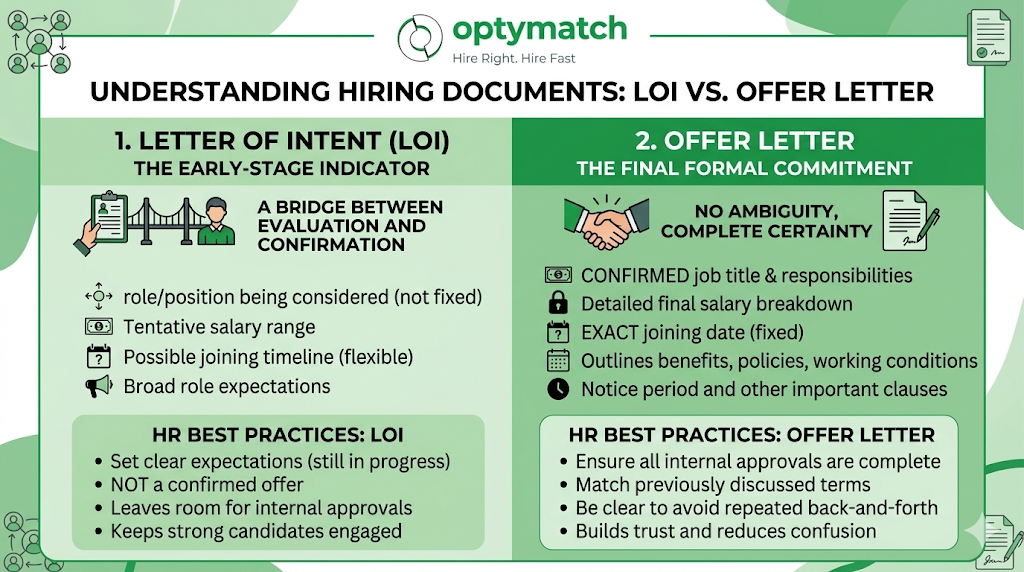
A Letter of Intent, or LOI, is an early-stage document shared with a candidate to indicate interest. It signals that the company sees potential in the candidate and is considering moving forward, but the hiring decision is not fully closed.
It is best understood as a bridge between evaluation and confirmation.
What does a Letter of Intent usually include?
A Letter of Intent gives a broad picture rather than final details.
- It mentions the role or position the candidate is being considered for.
- It may include a tentative salary range instead of a confirmed number.
- It can suggest a possible joining timeline, which is not fixed.
- It may briefly outline expectations from the role.
How should HR teams use a Letter of Intent?
A Letter of Intent should be used carefully and with clarity.
- It should set the right expectation that the process is still in progress.
- It should not be positioned as a confirmed offer.
- It should leave room for internal approvals, budget discussions, or role changes.
When used correctly, it helps keep strong candidates engaged without overcommitting too early.
What is an Offer Letter?
An Offer Letter is the final step in the hiring process. It is a formal document that confirms the company’s decision to hire the candidate.
At this stage, there should be no ambiguity.
What does an Offer Letter include?
An Offer Letter provides complete and confirmed information.
- It clearly states the final salary with a detailed breakdown.
- It confirms the job title and responsibilities.
- It includes the exact date of joining.
- It outlines company policies, benefits, and working conditions.
- It may include terms related to notice period and other important clauses.
How should HR teams approach an Offer Letter?
An Offer Letter should reflect certainty and alignment.
- All internal approvals should be completed before sharing it.
- The terms should match what has been discussed with the candidate.
- The document should be clear enough to avoid repeated back-and-forth.
A well-structured Offer Letter builds trust and reduces the chances of last-minute confusion.
The Core Difference Between a Letter of Intent and an Offer Letter
The difference between a Letter of Intent and an Offer Letter comes down to intent versus commitment.
A Letter of Intent shows that the company is interested, but it does not lock anything in place. An Offer Letter confirms the hiring decision and formalizes every detail.
From an HR standpoint, this difference is not just technical. It directly impacts candidate experience and hiring outcomes.
Why This Difference is Crucial for HR Teams?
Miscommunication at this stage can create avoidable friction.
When candidates receive a Letter of Intent that feels too close to a final offer, they may assume the job is secured. If there are delays or changes later, it can lead to frustration and loss of trust.
On the other hand, if an Offer Letter is delayed after strong verbal confirmation, candidates may start exploring other options.
Clear positioning of both documents helps in:
- Managing candidate expectations without confusion.
- Reducing drop-offs between final rounds and onboarding.
- Building a more transparent hiring experience.
Common Gaps That Show Up in Practice
Even structured hiring teams face challenges with these documents.
- Letters of Intent are sometimes shared without clearly stating that they are not final.
- Offer Letters are delayed due to internal misalignment.
- Details discussed verbally do not always match the final document.
- Candidates are left uncertain about where they stand in the process.
These gaps may seem small, but they can affect acceptance rates and overall hiring efficiency.
Making the Process More Structured
To avoid confusion, HR teams need consistency in how these documents are created and shared.
- There should be a clear internal definition of when to issue an LOI versus an Offer Letter.
- Communication around both documents should be aligned across recruiters and hiring managers.
- Candidates should always know whether they are in a consideration stage or a confirmation stage.
A structured approach reduces dependency on individual judgment and creates a smoother experience for everyone involved.
Final Thoughts
A Letter of Intent and an Offer Letter may look similar on the surface, but they play very different roles in the hiring journey. One signals possibility, while the other confirms a decision.
For HR teams, the goal is not just to use the right document, but to use it in the right way. Clarity, timing, and consistency can make a significant difference in how candidates respond and how smoothly hiring moves forward.
This is where platforms like Optymatch can support hiring teams by bringing more structure and clarity into the process. By helping streamline communication and reduce gaps between intent and confirmation, Optymatch enables HR teams to create a more reliable and efficient hiring experience.